
A newly published paper consolidates more than a decade of international work on Essential Ocean Variables – the core measurements that enable a truly global, integrated ocean observing system.
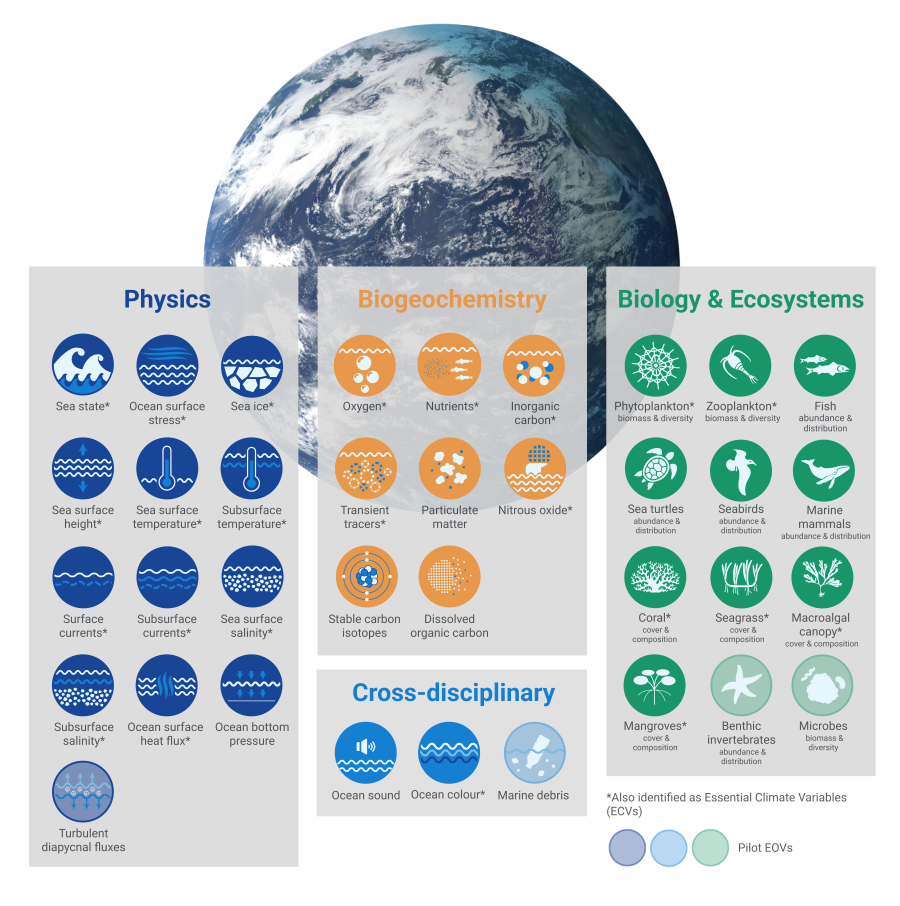
Since its inception in 1991, the Global Ocean Observing System (GOOS) has worked toward a single overarching goal: to enable a truly global, coordinated, and sustained ocean observing system. that delivers the essential information needed for our sustainable development, safety, wellbeing and prosperity. Central to this vision is the concept of Essential Ocean Variables (EOVs), defined as the minimum set of ocean observations that are needed to assess ocean state and variability for important global ocean phenomena, and to provide essential data for applications that support societal benefit.
“First introduced more than 15 years ago, the EOV concept started a shift away from fragmented, platform- or region-specific observations toward a system-based approach, where diverse observing efforts contribute to shared global objectives,” says Emma Heslop, GOOS Programme Specialist and co-first author of the new paper (Martin Miguez & Heslop et al. 2026) published in Frontiers in Marine Science.
The newly published paper, co-authored by many members of the GOOS community, is an important milestone and a key building block for the global ocean observing community, describing how EOVs are defined, governed, and used, and outlining how the framework should continue to evolve to meet rapidly expanding scientific, societal, and policy needs.
How are EOVs used?
Today, GOOS recognizes 36 EOVs which span physical, biogeochemical, biological and ecosystem domains. Together, they form the backbone of a sustained and evolving global ocean observing system, delivering value for science, services, and decision-making across a wide range of applications and economic sectors.
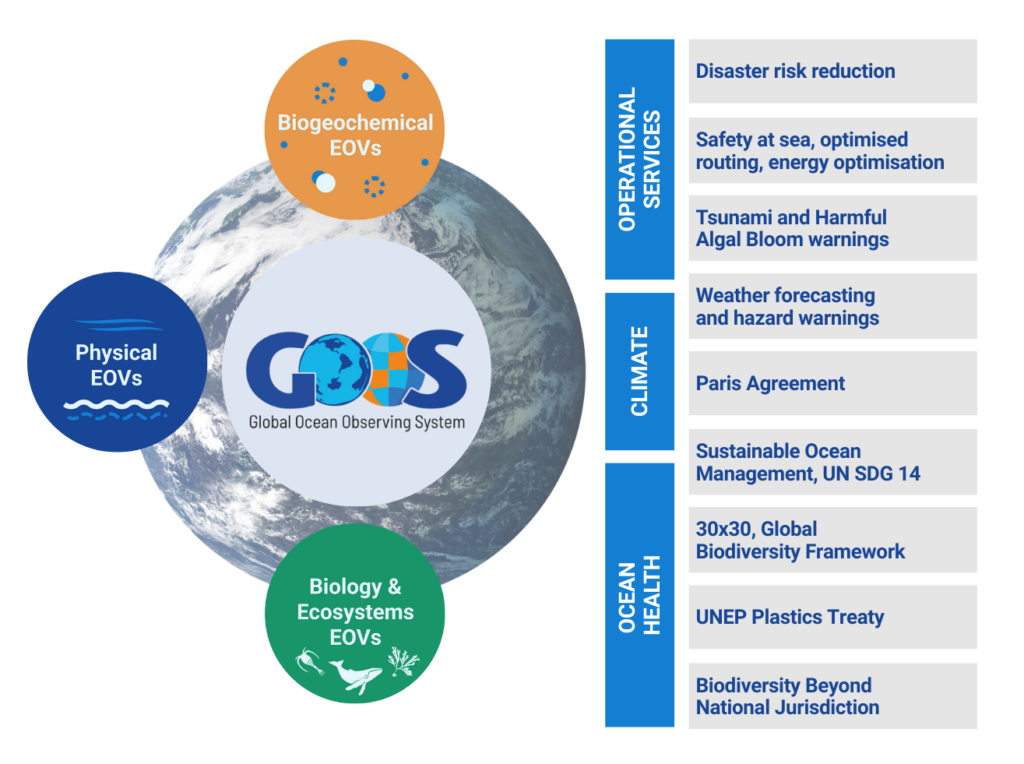
“EOVs provide a shared scientific foundation. By focusing efforts on a core set of agreed measurements, the EOV framework helps ensure that ocean observations collected around the world are interoperable and able to deliver maximum societal benefit for all user needs, from forecasting to marine protection, from safety at sea to economic resilience,” says Belén Martín Míguez, scientific officer of the GOOS Expert Panel of Physics and Climate (OOPC) and co-first author of the paper.
Many EOVs underpin the global assessments and tracking required by Member States to meet their commitments under international agreements. For example, in the annual State of the Global Climate report produced by the World Meteorological Organization (WMO), five out of the seven Global Climate Indicators used are directly based on EOVs. Biological and ecosystem EOVs can also be used by nations to inform and report on the Convention on Biodiversity Kunming-Montreal Global Biodiversity Framework targets.
The global in situ GOOS networks are required to observe EOVs and are using shared practices in order to ensure the observations are interoperable and delivered to operational systems with appropriate quality and timeliness. This enables their use in weather and ocean forecasting, monitoring, early warning systems and other operational ocean services.
Biological and ecosystem EOVs are foundational building blocks for assessing changes in marine life and ecosystem status, helping inform decision-makers on actions towards the sustainable use of our ocean. These EOVs serve as a point of connection for biology and ecosystem observing communities to collaborate and improve how ocean observations are collected and managed, so these observations can be comparable across scales and serve multiple purposes, including assessment of ocean health. This role is explicitly recognized within the UN Ocean Decade Vision 2030 White Paper on Challenge 2: Protect and Restore Ecosystems and Biodiversity, which highlights that establishing a scientific framework for sustainable development will rely on convergence around a practical set of essential ocean biology and ecosystem variables, drawn from those defined by GOOS.
Evolving and strengthening the EOV framework
As the EOV framework has matured, so too has the need to strengthen how new EOVs are proposed and adopted. The paper highlights the importance of a more transparent and well-documented process – one that clearly articulates how essentiality is assessed, how readiness is evaluated, and how decisions are made across disciplines. Establishing regular review cycles and shared criteria will help ensure that the GOOS EOV framework remains focused, credible, and responsive to emerging scientific and societal priorities.
The ocean observing landscape includes several complementary “essential variable” frameworks, such as the Essential Climate Variables (ECVs) defined by Global Climate Observing System (GCOS) and the Essential Biodiversity Variables (EBVs) defined by the Group on Earth Observations Biodiversity Observation Network (GEO BON). While this overlap reflects the broad relevance of core ocean measurements, it can also create confusion and duplication if not carefully aligned. “We emphasize the need for continued coordination and dialogue between the organizations stewarding these frameworks to ensure that the same measurements can efficiently serve multiple purposes, from climate reporting to biodiversity assessment,” says Belén Martín Míguez.
Importantly, EOVs are positioned as foundational scientific measurements, from which global ocean indicators are derived. While indicators translate data into policy-relevant information, EOVs provide the consistent, high-quality observations that make such indicators possible. This role is further reinforced by the recent publication on global ocean indicators, which highlights the need for indicator frameworks that are explicitly built upon sustained, interoperable EOV data streams.
As user needs grow and observing technologies advance, there is also an increasing demand to include new variables within the EOV framework. At the same time, maintaining the “essential” nature of EOVs is critical to avoid dilution and loss of focus. The paper urges a balanced approach: allowing the framework to evolve, while preserving its role as a prioritized, manageable set of core measurements.
“We must acknowledge that, in some cases, EOVs may be refined or even withdrawn as scientific understanding and observing capabilities change. Treating EOVs as part of a living framework, rather than a static list, is key to ensuring the long-term relevance and impact of the framework,” says Emma Heslop.
A framework for the future
As global demands for ocean information continue to grow, the need for a coherent, fit-for-purpose ocean observing system has never been greater. By strengthening governance, improving alignment across global frameworks, and maintaining a clear focus on essentiality, EOVs will continue to serve as the backbone of a sustained and evolving global ocean observing system.
“EOVs underpin the entire Global Ocean Observing System. They allow us to measure and compare ocean data from all around the world, and turn a complex ocean into accessible information for governments, industries, and society,” says Joanna Post, GOOS Director.
“Our task now is to continue strengthening and evolving this framework and its coordination together with governments and the global observing community, ensuring it remains responsive, inclusive, and fit for purpose in the years ahead.”
– Joanna Post, GOOS Director